

Musings of a Trans Woman in Tech
I’ve spent two decades working in tech. I’ve been an engineer, a CTO, a co-founder, a director, a team lead, a QA... you get the picture. For most of that time, I was ostensibly moving through the industry as a cishet (meaning cisgender and heterosexual), white, middle-class male. In reality I was a queer AuDHD trans woman living with an exhausting double mask.
And now? Now I’m still a queer exhausted AuDHD trans woman, but the masks are gone.
My colleagues and clients know me as Abi. Many have only ever known me as Abi. They’re used to seeing me on video calls anywhere from fully made up with one wig or another, to a bandana covering my real hair, no makeup, and quite possibly unshaven in a dysphoria hoodie.
The wonderful part is that no one cares. No one judges. I’m just accepted as Abi. And I know how incredibly lucky I am to work for a company like this - especially in the tech sector. Even more so today as LGBTQIA+ rights and safeties are being systematically eroded in public and corporate life.

Differentiating Sexuality and Gender Identity
I don’t want to play into the hands of the “LGB without the T” crowd who try to divide our community from within. But when it comes to diving into the challenges faced by our community - especially from a legislative and corporate sense - we do need to separate sexuality from gender identity. Because while we share a history of resistance and culture, as well as the need for political solidarity, the challenges faced by the two can diverge wildly.
This is exactly where corporate policy often falls down. A single rainbow logo on LinkedIn and a handful of cursory policies treat fundamentally different life experiences with the same flat approach.
Sexuality (LGB/A+)
I came out as bisexual at 17, mostly because 1990s-me didn’t realise that “panromantic asexual” was even a thing, let alone that it would come to define my relationships for the next few decades. But because I spent most of my adult life in long-term relationships with women, as far as anyone was concerned I was cishet - which is honestly the safest mode to play on.
For sexual minorities (lesbian, gay, bi, pan, ace), the real struggle in a corporate environment is one of filtering and cultural normalisation. It’s the draining mental tax of editing or omitting details about your weekend during the Monday morning catch-up. It's weighing up the psychological safety of bringing your partner to an after-work event, or calculating the potential career cost of revealing who you love.
Now when I speak about my exes and use female pronouns, it hits differently. It’s not seen as het any more, but it is something distinct from my day-to-day gender presentation (even if being trans still confuses some people’s ideas about what straight and gay actually mean for me).
Gender (Trans, Non-Binary, Genderfluid, Intersex)
Transitioning in your mid-forties isn’t a lifestyle choice or a social preference as much as a complete structural overhaul of your life. It’s about who you show up as every single day. And unless you’re "lucky" enough to pass, it’s not something you can hide while remaining authentically you.
For employers, there are so many more operational responsibilities and considerations when supporting transgender employees. There’s updates to databases - diligently enough to prevent automated deadnaming. There’s synchronisation of wage and tax records - especially where names and identification don’t yet align. There’s managing medical leave; guaranteeing suitable facilities; ensuring the right people are notified (and only the right people);... the list goes on.
And while I’ll never downplay the issues faced in terms of sexuality-based discrimination, the day-to-day administrative and physical differences are there, and they do matter.
Comorbidities and Common Pain Points
Like many others in my position, I’m not navigating my identity in a vacuum. I’m doing it against a backdrop of AuDHD, depression, and anxiety.
I say “like many others” because psychiatric data highlights some startling comorbidities within the LGBTQIA+ community. Sexual minorities are roughly twice as likely to experience mental health conditions as their cishet peers, while transgender individuals are nearly four times as likely. On top of this, research from the University of Cambridge shows that transgender and gender-diverse people are 3 to 6 times more likely to be autistic than cisgender people.
For neurodivergent people, masking to fit into standard social hierarchies is a daily, exhausting reality. Add in the weight of either hiding your identity or navigating transition in a corporate environment, and that double masking will burn through the strongest person’s emotional reserves.
But beyond the baseline psychological toll of minority stress, the biological reality of medical transition introduces an entirely new layer of vulnerability: puberty.
Because yes, HRT literally triggers a second puberty. Along with all the intense emotional volatility, temporary burnout, occasional age or skill regression, and everything else that comes along for the ride. Most of us remember our first puberty - or we’re watching it happen again with our own children. And, honestly, would you willingly throw that person straight into the stresses of the workforce without a safety net?
Organisations need at least that baseline understanding that a transitioning employee is going through an intensive biological process. That HRT triggers real and profound biological changes that cause emotional and functional peaks and troughs with no rhyme or reason.
Take my own experience. I’d only been at my new job for a few weeks when all these intersecting forces threw me into a severe mental health spiral. In a traditional workplace, a new hire struggling so early on is frequently flagged as an administrative problem or a "poor culture fit."
But when I say I’m privileged to work where I do, I mean it.
My team treated me with genuine empathy, offering flexibility and safety without judgement while I got back on stable ground. As an employee balancing neurodivergence, high-level technical responsibilities, and the emotional storm of early HRT, that protective environment was life-saving.
Sadly, this level of care is a rare exception across the wider job market. And that’s something that needs to improve, otherwise we’re going to continue losing talented workers across all industries.
Culture and the 15-Minute Vulnerability Test
Culture is only functional if it runs from top to bottom, and is driven by an organic understanding of what minoritised staff actually need to thrive. For me, what I want (and need) is simple:
- I want to be treated like any other woman in the room (without systemic misogyny for any of us, please)
- I want to feel comfortable and safe enough to speak freely about my identity and journey without constantly self-editing or censoring my history
- I want to know that my presence in front of clients is not seen as a liability, and
- I want to know that if external prejudice does occur, leadership will unequivocally have my back rather than throwing me under the bus to appease a client's bias
- I want to feel valued and accepted for who I am, and what I bring to the role.
Now, I’ve experienced company cultures that did not support minority needs, or respect diversity, but I would rather focus on the positives of a supportive environment than revisit spaces where I felt unsafe.
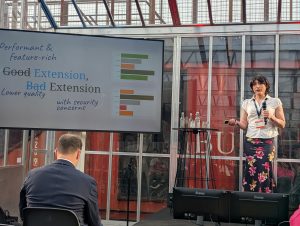
Very soon, it will be my turn to give an official employee introduction to the rest of the company. This isn't just a brief, two-minute run-through of my CV; it’s a 15-minute presentation about me - who I am outside of what people see at work. There are slides. There are pictures. There will be embarrassing videos.
For a trans person (especially one transitioning as recently as me), this kind of presentation is a minefield. There are decades of history spent behind a mask, documented in photos that look entirely different from the person sitting in the video calls today.
Without prompt, my leadership team raised this potentially awkward situation with me tactfully and discreetly. They offered me immediate options and accommodations to ensure I felt completely safe and comfortable. And this is the kind of proactive HR we need as an industry standard: a team that implicitly recognises the psychological weight of an administrative requirement and moves early to support the individual.
The irony is that because the company embodies this culture, I don't feel the need to shrink. I’m not going to hide “him” in the archives, because there is no one here I need to protect myself from. My slides are going to feature beards, muscles, and top hats. They’ll feature awkward early transition pictures and honest photos of my family through the years.
What they won’t feature, however, is a discussion of my sexuality. Honestly, I doubt it will be mentioned at all - not because I’m ashamed, but because it simply isn't relevant to the story. Which, again, highlights the fundamentally different concerns and coping mechanisms between the two faces of LGBTQIA+.
Beyond Luck
Now, earlier I described myself as lucky to work where I do. But that isn't strictly true. Yes, I was fortunate that an opportunity opened up when it did, but I knew the kind of company I was applying for far in advance.
While this policy of acceptance is written into our company values, those values are completely meaningless unless they’re followed through every single day. They need to be fiercely guarded by hiring decisions. Interview processes need to filter for empathy; respect; and authenticity, so you don’t just end up with begrudging compliance.
It is no coincidence that we have a low staff turnover. My team members aren’t "tolerant" because HR tells them they have to be; they’re just genuinely good people who treat human dignity as the baseline expectation.
After forty years of playing a part before finally expressing myself authentically, I understand what it means to lose privilege. I know what it looks like to navigate a world that is actively trying to legislate my community out of existence. But I also know the pure and profound joy that comes from being myself in a workplace that is, most of the time, beautifully apathetic to the fact that I’m trans, pan, or ace.
Where I can lay my history on the table when it’s relevant, know that it’s respected, and know that it won’t be weaponized against me.
Where I’m judged solely by the quality of my work.
Creating a safe, inclusive, and genuinely respectful workplace is not an act of corporate charity. While it is absolutely the right thing to do morally, it benefits the business directly. A workplace where employees don’t have to spend half of their daily energy holding up a mask just to survive is a workplace that can direct that collective energy into creating something truly exceptional.