

How To Be An Ally In A Shifting Employer Landscape
In the previous article, I dived into the reality of being an LGBTQIA+ member of the workforce from a personal perspective. Of finally dropping those masks within a workplace that goes beyond performative acceptance, and why that is so important to vulnerable individuals.
But while I’ve been incredibly fortunate to find an environment in which I can thrive, the reality for many is the opposite. Masking for safety. For career progression. Or just for peace of mind.
And if we take a step back and look at the bigger picture of diversity in the workplace, things become a lot more concerning. If we look at corporate infrastructure rather than isolated company cultures, we start to find a landscape riddled with systemic inequality; misleading statistics; and legal quagmires.
Founders, executives, and HR teams are increasingly finding that checkbox compliance isn’t the safety blanket it once was; that DEI by numbers doesn’t satisfy either side; that the frameworks they’ve relied on until now are actively exposing them to more risk.
To protect and support our vulnerable members, and to safeguard the companies themselves, we need to move past performative inclusivity and throwaway satisfaction scores, and re-engineer our diversity and inclusivity frameworks from the ground up.
This is Part 2 of a two-part series exploring the realities of workplace equality for the LGBTQIA+ community, based on my own personal experiences and the wider political and legislative climate.
In Part 1: Musing of a Trans Woman in Tech I looked at my own journey as a queer, neurodivergent trans woman navigating the corporate world. In Part 2, we take a look at the infrastructure in that landscape: analysing metrics; recent case law; and give some pragmatic steps you can take to be a genuine ally to your minoritised staff.
Minority Attrition in Numbers
In Part 1 we discussed how there are two distinct sides to the LGBTQIA+ community when it comes to workplace satisfaction, each with different needs and support structures. And if we look at the numbers, it’s clear that while acceptance for sexual orientation still has some way to go, employees with gender diverse identities are being failed entirely.
You only need glance at the CIPD Employment Relations Survey on LGBT+ Inclusion to see the stark experience gap between cohorts.
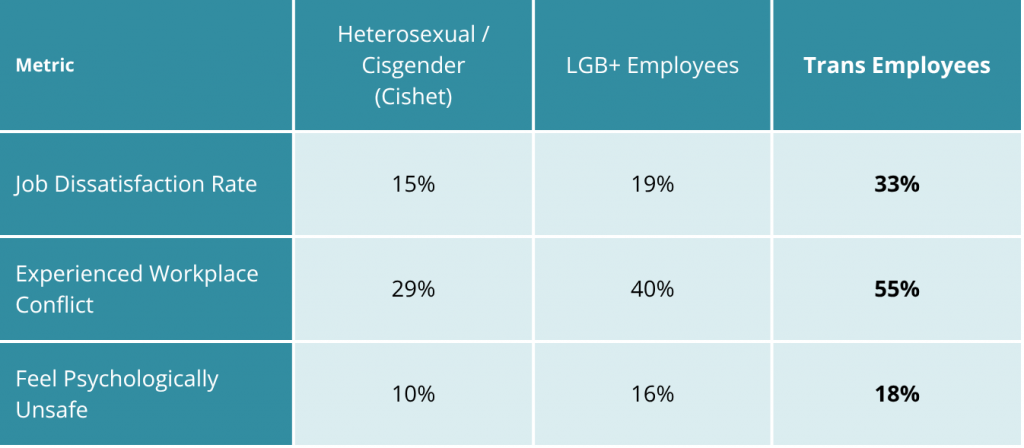
For LGB+ employees, job dissatisfaction and feeling psychologically unsafe are elevated, but corporate inclusion frameworks; cultural normalisation; and decades of targeted advocacy are clearly yielding measurable results (although trends are starting to reverse in the current hyper-populist political environment). While not as fast as we’d like, we can say that the initiatives are having an impact.
However, the second we pivot to gender identity, those figures collapse. With over half of trans employees experiencing workplace conflict, and a third outright dissatisfied with their place of work, it’s clear that gender diversity initiatives are out of their depth.
And that’s if a trans person is even hired in the first place. Research by Crossland Employment Solicitors revealed 33% of UK employers openly admitting they would be less likely to hire a transgender applicant. And - as we continue to lag behind other industries - that figure rises to a terrifying 45% in the tech sector.
Between the gatekeeping and hostile work environments, there’s no wonder unemployment rates follow the same pattern, with a baseline unemployment rate of 5% for cishet people climbing to 9% for sexual minorities, before spiking at a staggering 15-20% for gender diverse individuals.
So while diversity frameworks fail to support trans professionals within the system, they’re also locking a huge number out of the system entirely.
Now, of course, this all assumes that our data is clean. Spoiler: it is not. Under and mis-reporting is always a problem with any dataset, but especially so with a sensitive topic such as this. Which is why it’s so ridiculous (or understandable, should you be prone to conspiracy theories) that recent compliance frameworks are corrupting the data pool by forcing metrics to be reported based on sex assigned at birth. And that bad data is obscuring a massive operational crisis.
Traps and Universal Pain Points
While all having unique concerns, all underrepresented groups - whether marginalised by race, gender, disability, orientation, or any other protected characteristic - share some structural pain points. One of the most dangerous being The Grievance Trap.
Now, standard corporate compliance advises victims of bias or harassment to “raise a formal complaint”, however in an unsafe environment putting your head above the parapet like that often puts you in more danger. Which is why trade union data shows that up to three quarters of LGBTQIA+ staff avoid reporting serious bullying to HR for fear of either inaction or retaliation.
Retaliation which often comes in the form of counter-grievance, which is ostensibly a means to ensure the accused’s story is heard in full but, in practice, has been weaponised against the real victims.
Take, for example, a minoritised worker who sets a boundary or reports harassment, where the perpetrator will frequently file a retaliatory complaint claiming the victim was “aggressive” or is “damaging team harmony”. And as soon as this hits HR, standard procedures transform the victim into the subject of a disciplinary investigation. Do that enough times and systemic feedback get silenced - through fear or dismissal.
Impact of The Supreme Court and EHRC Rulings
In case the news slipped by, in April 2025 the Supreme Court ruled that the term “sex” within the Equality Act 2010 refers strictly to assigned sex at birth. A ruling which has been increasingly weaponised and used outwith its remit by the growing “gender critical” movement. In May this year, the Equality and Human Rights Commission released its guidance on the case which, as Freedom of Information Act requests uncovering structural gender-critical bias within the commission have since revealed, formalised transgender exclusionary policy in both the workplace and society at large (note: at time of writing the guidance is still to be approved by Parliament).
Under the guise of “proportionate means to a legitimate aim”, transgender protections have been slashed again as the UK continues its slide on LGBTQIA+ rights. A policy of appeasement which not only attacks one of the most vulnerable demographics in society, but creates myriad dangers and complications for employers.
By uncoupling lived gender from the statutory definition of “sex”, this guidance also compromises legal protections for the wider LGBTQIA+ community under the very Equality Act they claim still provides the same levels of protection.
For example, let’s take a trans woman who “passes” and is in a relationship with another woman. Now imagine she is a target for homophobic discrimination or harassment as a result of this relationship. If she files a sexual orientation claim, a hostile employer can argue that because she is “biologically male”, the relationship is statutorily heterosexual - erasing the homophobia claim. If she pivots to "Gender Reassignment" protections, the employer escapes liability because the perpetrator was unaware she was transgender.
The Supreme Court has already shown it doesn’t consider the implications of its rulings when they relate to LGBTQIA+ protections - as evidenced in its ruling on Lee vs Ashers Bakery Company in 2018 . A ruling which set a highly problematic distinction between protection of a minoritised person vs a message.
A distinction which we’re now seeing the recent ruling allowing to simultaneously be flipped on its head as bad-faith companies and organisations try to bypass accountability by adhering to some mechanical, state-sanctioned Get Out Of Jail Free card in “biological sex at birth”.
But it goes beyond this. Biological reductionism will fundamentally break reporting mechanisms designed to ensure that minorities are treated fairly. And, yes, this is going to hurt cis women along the way as we watch:
…A false compression of the gender pay gap
Yes, there are people like me who transitioned after forging a good career; and yes, this ruling means my contribution would increase the gender pay gap. But I’m an outlier. According to a recent report by the Human Rights Campaign Foundation, transgender women earn 60% of the wage of the average American worker (OK, it’s a US study). Suddenly pushing these figures into the male column allows companies to claim much smaller gender pay gaps, hiding the actual disparities between men and women and hurting all women in the process.
…A statutory shield created for wage and career suppression
And as a corollary to that? A gaping hole in accountability making it much easier for hostile employers to suppress a trans woman’s wages; overlook her for promotions; or make her redundant without triggering red flags on a gender-based equality audit.
…A distortion of grievance data
Beyond wages and job security, trans women are frequently the targets of toxic behaviour, but this reductionism blinds HR departments to its scope. This is just “male on male friction” now; dismissed as just two men “bumping heads” rather than the gender based issue it is. And because trans women aren’t targets solely because we’re trans, we also get to experience your everyday misogyny, too. Hiding this away threatens the safety of every woman in the building.
…An environment of suspicion that hurts all women
Most insidiously, though - biological policing invites an environment of hyper-surveillance that we’re already seeing in everyday life (such as when JK Rowling suggests taking pictures of women who don’t appear feminine enough and posting them online).
Cis women punished by biological policing and “transvestigation” if they dare deviate from patriarchal standards of behaviour and presentation. Masculine-presenting women, lesbians, athletes (and let’s not even get into the degrading and invasive ruling the IOC recently introduced to protect women from a nonexistent threat) - anyone deemed not “feminine” enough.
For businesses, implementing these gatekeeping practices seems like the easiest way to protect themselves from the fallout of the EHRC ruling - right up until they see discrimination claims (which carry uncapped financial awards) from the very people supposedly being protected.
How To Be A Corporate Ally
So, in this current climate, what can employers and businesses do to actually make a difference and support LGBTQIA+ staff; customers; and visitors?
Well to start it takes more than wearing a rainbow lanyard and posting some “thoughts and prayers” pinkwashed LinkedIn statuses, all the while staying silent during actual workplace discrimination. It takes having the courage to speak out - immediately - when a minoritised colleague is talked over; deadnamed; or dismissed. And it means proactively interrogating company policies, recruitment practices, benefits packages, and other underlying practices.
Active allyship demands boundaries with teeth. For example, never out someone without their explicit consent. Exposing transition history; sexual preferences; or deadname is a profound violation of safety and dignity and requires swift and consequential disciplinary action.
Inclusion needs to be treated as an infrastructure issue. Your entire corporate setup needs to be overhauled. You need concrete policies and actions to safeguard your workforce - even if that comes into conflict with hostile state guidance. This includes things like:
Zero-Tolerance Outing Policy
Handbooks, contracts, and other policy documents should be updated to make it clear that unauthorised disclosure (directly or through insinuation) of any protected characteristic is a severe breach of conduct with serious consequences.
Instant, Discreet Preference Updates
Internal directories, payroll, HR, and other systems should allow users to update their own preferences easily and immediately. Yes, some information has more stringent controls against fraud, but the vast majority of an employee’s day-to-day information should not be shut away.
Privileged Access Control
And for those more tightly controlled pieces of data (such as documented gender, historical names, etc)? Access must be limited to privileged staff only.
Normalisation of Pronouns
Yes, it’s become a cliche and will no doubt invoke the ire of the anti-”woke” mob, but pronoun usage should be normalised across all platforms associated with the company - internal, such as messaging, and public-facing, such as email. For many minoritised employees, pronoun usage adoption is one of fundamental indicators of safety in an environment.
They/them should also be encouraged as a default until someone’s pronouns are explicitly established.
Blind Recruitment
Names and other gender indicators should be removed from CVs and applications before reaching hiring managers (whether that’s AI or human-based) to prevent unconscious gatekeeping in early stages of recruitment.
Gender Neutral Spaces
One of the items more likely to be skipped over, due to cost or logistics, the best way to push back against the misguided EHRC guidance is to make spaces gender neutral and self-contained.
- Shared gender neutral spaces risk distress and harm to employees for the sake of a political point.
- Forcing transgender women to use men’s spaces risks distress and harm to employees.
- Forcing transgender men to use women’s spaces risks distress to employees, and
- Forcing transgender employees into “third spaces” impacts disabled employees’ access to these facilities, while taking us into a 21st century Separate But Equal
And a side note for employees reading, remember that legal cases are brought against the institution, not the individual so, you know, it’s your decision how to respond to the options presented to you.
Avoiding Performative Allyship
We don’t need rainbow cupcakes and a once-a-year, supportive LinkedIn post. We need action. We need to know that diversity and equality are a fundamental part of the company we’re a part of. And that can include:
SMART Equity Initiatives
Specific; Measurable; Achievable; Relevant; and Time-Bound goals developed in consultation with members of the impacted communities with quarterly reviews on progress. And then you can congratulate yourself once a year if deserved.
Sponsorship and Volunteering Initiatives
Provide volunteering time in lieu for employees - especially for minority causes - and actively encourage and measure participation. Let team members guide choices for corporate sponsorship and, where possible, favour smaller-scale grassroots events where the support will have a much bigger impact.
Vetted, Unconditional Benefits Policies
Ensure that company policies are unambiguously inclusive of LGBTQIA+ staff - don’t just rely on assumptions and expected interpretations. Pensions, leave policies, insurance, healthcare… they all should make explicit mention of diverse family structures, specific leave reasons, gender-specific medical benefits, etc.
And this includes Employee Assistance Programs. Please, rigorously vet your providers and ensure they are capable of providing appropriate levels of care for minoritised staff. Health partners who insist an employee “resolve [their] gender issues” or “finish their transition” before offering mental health support can do significant harm to a vulnerable person near breaking point.
Top-Down Governance and Cultural Accountability
Diversity and equality initiatives within a business will sometimes trigger pushback from staff believing the culture has gone “too woke”. The temptation will be to play down or row back on some initiatives. We’ve all seen it play out - throw the minority staff under the bus in order to keep the peace.
Being a true ally means taking advantage of these conflicts to let the bad-faith employees identify themselves, and allowing management to take swift action and set precedent.
At the same time, reward and engage allies; demonstrate how valued they are for building a respectful and supportive environment (even if that appreciation does need to be handled with discretion at times).
I noted in part 1 that culture is only functional when it runs top-to-bottom. Management, directors, C-suite all need to demonstrate that they embody the company ethos, and value diversity not as some checkbox ticking exercise but as a real intrinsic tenet of the company.
In such a fractured social; political; and legal landscape, it takes courage to stand up for what is morally right. Especially when there are so many examples of the backlash it invites from anti-woke groups. But this is what makes it so important. Why we need those with the ability to enact change to build safety, respect, and acceptance into the fabric of their companies.
It’s time for employers to stop just talking about awareness and actually start fixing the systems.